
Share
Welcome to the second blog in our three-part series on elevating leadership in the Early Years sector. In our first post, we explored how true delegation is about building capability, not just offloading tasks. Today, we are tackling the natural next step – and often the hardest part of leadership: accountability.
In my work coaching Early Years leaders and guiding them through the 9-Step Management Mastery program, accountability is frequently the stumbling block. When we reach Step Five – Safeguarding & Compliance: Creating a Culture of Safety and Accountability, I see a recurring pattern. Leaders either avoid accountability entirely for fear of upsetting their team, or they swing to the opposite extreme, micromanaging every detail until their staff feel suffocated.
The fear is real. In a sector facing a recruitment and retention crisis, many managers worry: “If I hold them to account, they will leave.”
But the research tells a different story. People do not leave because of high standards; they leave because of poor management and unclear expectations.

When we think of accountability, we often picture a harsh spotlight – a glaring beam that highlights every mistake and flaw. No wonder we shrink from using it. If we shine that spotlight on a struggling practitioner, they will feel exposed, ashamed, and defensive.
Instead, I want you to think of accountability as scaffolding.
When you erect scaffolding around a building, you are not doing it to restrict the building’s growth; you are doing it to support the structure while it becomes strong enough to stand on its own. Good accountability is exactly the same. It provides the necessary framework, boundaries, and support for your team to develop their skills safely.

If a practitioner is struggling with their key person paperwork or managing a challenging behaviour in the toddler room, ignoring the issue (removing the scaffolding) does not help them. It leaves them unsupported and likely to fail. Conversely, shining a harsh spotlight on their failure only creates fear.
But if you provide scaffolding -clear expectations, regular check-ins, and targeted support -you are saying: “I see you are struggling, and I am going to put this structure in place to help you succeed until you no longer need it.”

The Early Years Alliance recently reported that the sector is facing a staffing crisis, with many settings struggling to recruit and retain qualified practitioners. In this climate, the temptation to lower standards just to keep bodies in the room is overwhelming.
However, lowering standards is a false economy. Gallup’s extensive research on workplace engagement reveals that less than half of leaders excel at holding employees accountable, and this deficiency directly threatens engagement and performance . Furthermore, a lack of clear expectations -the very foundation of accountability – is one of the primary drivers of employee disengagement.

When you fail to hold people accountable, your high performers become resentful because they are carrying the weight of the underperformers. Your struggling staff do not improve because they are not receiving the feedback they need. Ultimately, a culture without accountability is a toxic culture, and that is what drives good staff away.
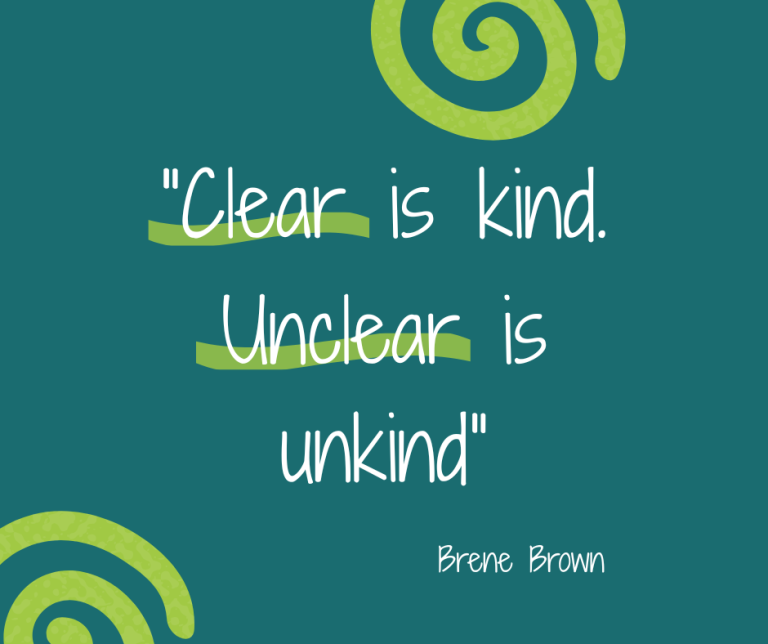
As leadership researcher Brené Brown famously says, “Clear is kind. Unclear is unkind” . Holding someone accountable to a clear standard is an act of kindness and support.
So, how do we move from the harsh spotlight to supportive scaffolding in our nurseries?
Accountability cannot be a surprise. When you delegate a task (using the Decide/Recommend/Inform framework from Blog 1), you must clearly define what success looks like. What is the deadline? What is the expected quality?
Do not wait for the annual appraisal. Use your regular 1:1 supervisions to check the scaffolding. Ask: “How are you progressing with the new planning format? What support do you need from me this week?” This makes accountability a continuous, supportive conversation rather than a punitive event.
When a standard is not met, address the gap between the expectation and the reality. “We agreed the learning journeys would be updated by Friday, but I see they are not complete. Talk me through what happened.” This focuses the conversation on the process and the support needed, rather than attacking the individual’s character.

Accountability is not about catching people doing things wrong; it is about supporting them to do things right. When you provide the right scaffolding, your team will feel safe, supported, and capable of reaching their full potential. And a team that feels supported and capable is a team that stays.

Identify one area where you have been avoiding holding a team member accountable. What is one piece of “scaffolding” (a clear expectation or a supportive check-in) you can put in place this week to help them succeed?
In the final blog of this series, we will look at how to pull all of this together to create a culture of continuous growth and operational excellence.
If you’re ready to feel more confident in your role and lead your nursery team with clarity and calm, the next Management Mastery Cohort starts in June.
It’s a practical, supportive programme designed specifically for nursery managers, with 9 step-by-step modules, real-world tools, and 1:1 coaching to help you navigate the day-to-day challenges of leadership with more ease. You’ll also be learning alongside a cohort of like-minded leaders, so you’re not doing it alone.
You can find all the details and join here.
With the ever-changing regulations and guidance, sign up to our monthly newsletter and mailings to stay current and keep up to date with running your childcare setting.
Simply enter your details below to join our mailing list.
By completing this form you are agreeing to our privacy policy You can unsubscribe at any time